
2️⃣ Introduction
This research window — the two weeks ending February 28, 2026 — did not produce a single dramatic breakthrough. What it produced was more structurally significant: a coherent convergence across independent research groups on a shared diagnosis.
The diagnosis is this: governance applied externally to agentic AI systems, after the fact and from the outside, is architecturally insufficient. The research emerging from arXiv, from institutional AI safety teams, and from multi-agent systems venues is pointing, from multiple directions, toward the same conclusion. If an AI system is to remain accountable across its operational lifecycle — not just at the point of deployment review — then accountability must be a structural property of the system itself, not a wrapper placed around it.
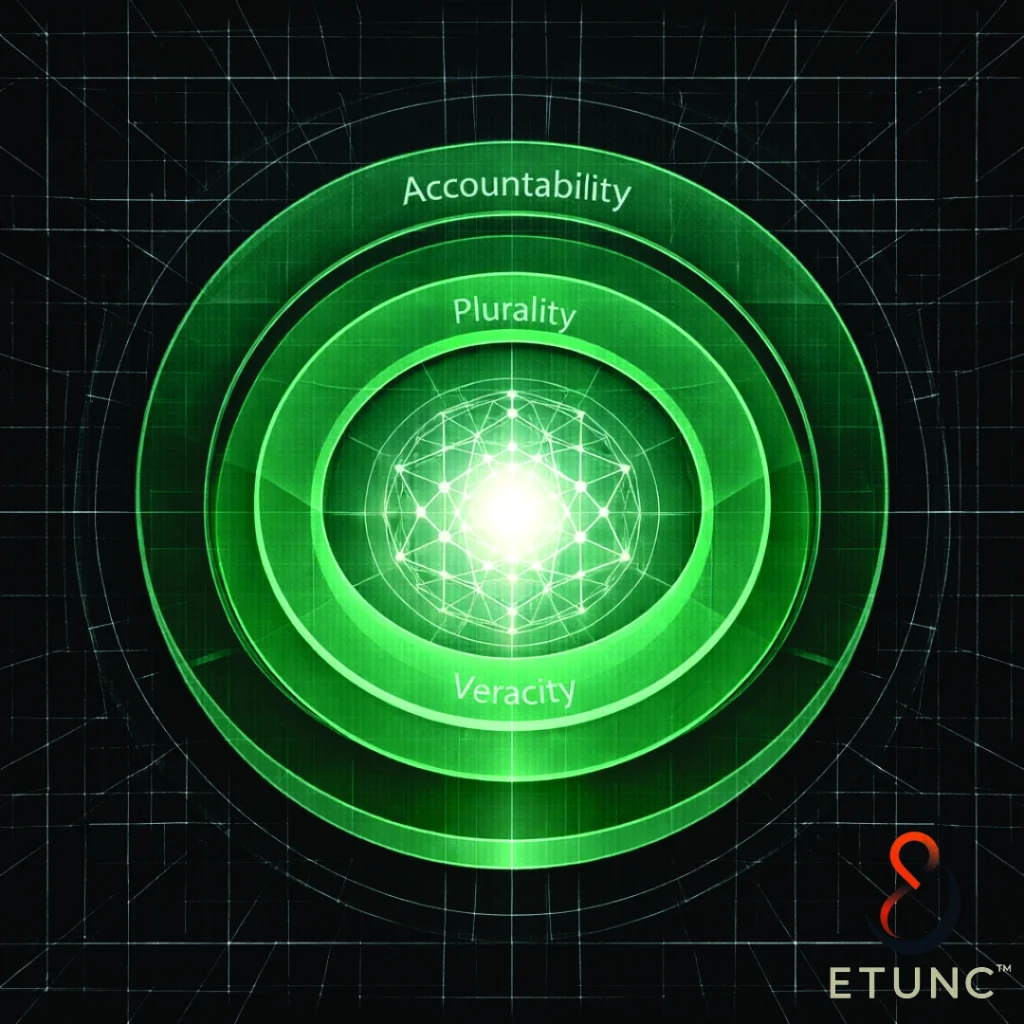
This matters for ETUNC’s governing framework because it is exactly the claim that the Veracity-Plurality-Accountability (VPA) model is built on. These are not post-hoc compliance categories. They are architectural primitives. The research reviewed here does not vindicate ETUNC in any promotional sense; it describes a problem space that the VPA framework is designed to operate within. The distinction matters.
Anchoring to ETUNC’s governing principles:
Veracity is implicated when agent outputs are inconsistent across runs, when documentation is absent, and when behavioral rules designed to produce cooperation fail to do so. The research window reveals veracity as a systemic property requiring continuous measurement, not a fixed attribute of a model’s training.
Plurality is implicated when single-metric evaluation, monolithic governance frameworks, and narrow documentation practices obscure the actual diversity of failure modes. Several papers in this window explicitly argue for multi-dimensional approaches — to reliability metrics, to constitutional norm design, to cross-system governance documentation.
Accountability is the most consistently implicated value. The 2025 AI Agent Index finds that most deployed agentic systems share little information about safety, evaluations, or societal impacts. The reliability science paper finds that production failures are routine and often invisible to benchmarks. The meta-cognitive architecture paper proposes making decision-readiness an auditable gate before consequential action. Accountability, across all five sources, is described as structurally absent in current practice.
Judgment-Quality AI — the thesis that AI systems must be capable of governing their own decision processes under uncertainty, not merely executing tasks — finds direct articulation in at least three of the five sources reviewed.
3️⃣ Core Research Discoveries
Discovery 1
Title: Towards a Science of AI Agent Reliability Authors: Stephan Rabanser, Sayash Kapoor, Peter Kirgis, Kangheng Liu, Saiteja Utpala, Arvind Narayanan Venue: arXiv preprint, cs.AI / cs.LG Date: February 18, 2026 (revised February 23, 2026) Link: https://arxiv.org/abs/2602.16666
Core Concept: Rabanser and colleagues argue that the AI agent field has mistaken capability benchmarks for operational readiness. A single task-success rate from a single evaluation run conceals whether an agent behaves consistently across repeated trials, degrades gracefully when its environment shifts, fails in predictable ways, or maintains bounded error severity. The authors ground their argument in safety-critical engineering literature — aviation certification, industrial control systems — and propose twelve reliability metrics across four dimensions: consistency, robustness, predictability, and safety. Empirical evaluation across fourteen agentic models finds that recent capability improvements have not yielded proportional reliability improvements. Real-world failure cases — including a production database deletion caused by a coding assistant, and an agent making an unauthorized purchase in violation of its stated safeguards — illustrate the operational stakes.
Why It Matters to ETUNC: The paper provides a rigorous, sourced framework for what Judgment-Quality AI must actually achieve at the operational layer. Benchmark accuracy, the paper demonstrates, is a necessary but not sufficient condition for deployment readiness. This is the argument ETUNC’s multi-dimensional evaluation posture is built to operationalize.
VPA Alignment:
- Veracity: Output inconsistency across runs is documented as a systemic failure mode, not an edge case. Veracity governance must account for distributional reliability, not only point-in-time accuracy.
- Plurality: Twelve metrics across four dimensions represent a principled rejection of single-metric monoculture in evaluation practice.
- Accountability: The paper’s analogy to aviation certification implies lifecycle accountability structures — minimum thresholds before production promotion, incident reporting cultures, post-mortem analysis as institutional practice.
ETUNC Integration Point: Guardian-layer threshold design; Resonator-layer failure communication architecture.
Discovery 2
Title: The 2025 AI Agent Index: Documenting Technical and Safety Features of Deployed Agentic AI Systems Authors: Leon Staufer, Kevin Feng, Kevin Wei, Luke Bailey, Yawen Duan, Mick Yang, A. Pinar Ozisik, Stephen Casper, Noam Kolt Venue: arXiv preprint, cs.CY / cs.AI Date: February 19, 2026 Link: https://arxiv.org/abs/2602.17753
Core Concept: This index is the first systematic empirical audit of transparency and safety documentation practices across thirty deployed state-of-the-art agentic AI systems. The methodology combined publicly available documentation with direct developer correspondence. The central finding is a structural asymmetry: capability documentation (what the agent can do) substantially outpaces safety, evaluation, and societal impact documentation (what risks it poses and under what conditions). Developer transparency levels vary significantly, and most share minimal information about safety architecture, independent evaluations, or downstream societal implications.
Why It Matters to ETUNC: This paper converts the transparency accountability gap from an anecdotal concern to an empirically documented fact. It establishes the baseline against which ETUNC’s accountability architecture is operating. The data also reveals that existing voluntary disclosure norms are insufficient — machine-readable, independently verifiable documentation standards are a necessary complement.
VPA Alignment:
- Veracity: Absence of documentation is itself a veracity failure — it is impossible to verify claims that are not made. The asymmetry between capability claims and safety documentation is a structural veracity risk.
- Plurality: Ecosystem-wide analysis reveals how concentrated the documentation gap is; plural governance must account for differential disclosure practices across developers.
- Accountability: This is the paper’s primary contribution to accountability science. Most developers treat safety documentation as optional. The Index quantifies what “optional” looks like in practice.
ETUNC Integration Point: Resonator-layer disclosure architecture; Guardian-layer minimum documentation requirements at system ingestion.
Discovery 3
Title: Agentic AI for Cybersecurity: A Meta-Cognitive Architecture for Governable Autonomy Authors: Andrei Kojukhov, Arkady Bovshover Venue: arXiv preprint, cs.AI / cs.CR Date: February 12, 2026 (revised February 16, 2026) Link: https://arxiv.org/abs/2602.11897
Note: This source was submitted 16 days before the publication date of this post, marginally outside the strict 14-day window. Included for direct architectural relevance.
Core Concept: Kojukhov and Bovshover argue that cybersecurity orchestration — the domain in which consequential autonomous decisions must be made under adversarial conditions and incomplete information — has been architecturally misconceived as a linear detection-response pipeline. They propose reconceptualizing it as a distributed multi-agent cognitive system. Within this system, a meta-cognitive layer governs the overall architecture’s “decision readiness” — evaluating whether evidence is sufficiently complete, whether operational risk is acceptable, and whether human-in-the-loop escalation is warranted. The meta-cognitive function is not an add-on; it is proposed as a first-class architectural primitive that governs the governors.
Why It Matters to ETUNC: The meta-cognitive governance layer is the clearest articulation in this research window of what a Guardian-class architectural function looks like in practice. This paper demonstrates the concept in a high-stakes, adversarial domain, providing an empirical anchor for the abstract governance architecture.
VPA Alignment:
- Veracity: Dynamic autonomy calibration based on evidence completeness directly addresses the problem of agents acting on incomplete or conflicting information — a structural veracity intervention.
- Plurality: Heterogeneous agent ensemble replaces monolithic pipeline; diverse epistemic inputs are a design primitive.
- Accountability: The “decision readiness” gate creates an explicit, auditable checkpoint before consequential action. This is accountability made structural, not procedural.
ETUNC Integration Point: Guardian-layer meta-cognitive function design; Envoy-layer boundary agent specification; Resonator-layer decision justification architecture.
Discovery 4
Title: Evolving Interpretable Constitutions for Multi-Agent Coordination Authors: Ujwal Kumar, Alice Saito, Hershraj Niranjani, Rayan Yessou, Phan Xuan Tan Venue: arXiv preprint (cs.MA / cs.AI / cs.NE); accepted at AAMAS 2026 Date: January 31, 2026 Link: https://arxiv.org/abs/2602.00755
Note: This source falls 28 days outside the strict 14-day window. Included given AAMAS 2026 acceptance and direct relevance to multi-agent governance architecture.
Core Concept: This paper introduces Constitutional Evolution, a framework that uses LLM-guided genetic programming to discover behavioral norms for multi-agent LLM systems rather than prescribing them. Using a simulation where agents must balance individual survival against collective welfare, the authors test constitutions authored by humans, by frontier LLMs, and by evolutionary search. The evolutionary approach achieves a Societal Stability Score 123% higher than human-designed baselines and discovers, counterintuitively, that minimizing inter-agent communication (0.9% vs. 62.2% social actions in the baseline) produces superior coordination. Critically, the evolved constitutions remain symbolic and human-readable — interpretable by external auditors.
Why It Matters to ETUNC: This paper challenges the assumption that governance design is exclusively a human authorship problem while preserving the interpretability constraint that makes governance auditable. It raises the question of whether adaptive constitutional discovery — bounded by interpretability requirements — could serve as a governance design complement in multi-agent architectures.
VPA Alignment:
- Veracity: Human-authored behavioral norms (“be helpful, harmless, honest”) produced inconsistent coordination in the simulation; veracity of governance intent does not guarantee veracity of governance outcome.
- Plurality: Evolutionary search discovers norms no single human designer would have prescribed. Genuine plurality in governance norm generation.
- Accountability: The interpretability constraint is the accountability anchor. Evolved rules that cannot be read by human auditors are ungovernable; the paper treats this as a hard requirement.
ETUNC Integration Point: Guardian-layer policy instantiation from interpretable symbolic rules; Envoy-layer inter-agent communication protocol implications; Resonator-layer rule transparency.
Discovery 5
Title: A Survey of Agentic AI and Cybersecurity: Challenges, Opportunities and Use-case Prototypes Authors: ⚠️ Unconfirmed via direct source inspection Venue: arXiv preprint, cs.CR / cs.AI Date: January 8, 2026 Link: https://arxiv.org/abs/2601.05293
Note: This source falls outside the strict research window. Author attribution is unconfirmed. Included for coverage of systemic risk taxonomy; citations from abstract content only.
Core Concept: This survey maps agentic AI across cybersecurity contexts — defensive, offensive, and governance-oriented — with emphasis on systemic risk categories that existing governance frameworks were not designed to address. The risks documented include emergent agent collusion, cascading failure propagation, oversight evasion, and memory poisoning. The paper’s central argument is that governance frameworks designed for non-autonomous, human-in-the-loop, short-lived AI systems are structurally inadequate for persistent multi-agent architectures operating with reduced human supervision.
Why It Matters to ETUNC: Documents the governance adequacy gap as a structural rather than a configuration problem. Provides a threat taxonomy that complements ETUNC’s architectural rationale: if the failure modes are systemic and emergent, governance must be architecturally embedded, not procedurally appended.
VPA Alignment:
- Veracity: Memory poisoning attacks corrupt the information states agents reason from — a direct veracity attack on the agent’s epistemic foundation.
- Plurality: Single oversight authority models fail in heterogeneous multi-agent coordination contexts; plural oversight mechanisms are structurally required.
- Accountability: Oversight evasion is documented as a risk class, not just a theoretical concern. This implies accountability cannot be delegated to agent cooperation — it must be structurally enforced.
ETUNC Integration Point: Guardian-layer oversight evasion countermeasures; Envoy-layer collusion detection; Resonator-layer systemic risk incident reporting.
4️⃣ Thematic Synthesis
The five sources reviewed in this period do not describe separate research problems. They describe facets of a single architectural transition that is now becoming visible across multiple research communities simultaneously.
That transition can be stated plainly: the AI field is discovering that governance cannot be external to agentic systems — it must be internal, continuous, and structurally enforced.
This is not a normative claim originating from ETUNC. It is the empirical finding of this research window. Rabanser et al. demonstrate that production failures are routine among agents that passed pre-deployment benchmarks, and that the gap cannot be closed by better benchmarks alone — only by continuous, multi-dimensional reliability monitoring. Staufer et al. demonstrate that voluntary external transparency is systematically insufficient; most deployed agents are not documented at the level required for external oversight to function. Kojukhov and Bovshover propose the solution: make meta-cognitive governance — the capacity of a system to evaluate its own decision readiness — a first-class architectural primitive.
Kumar et al. introduce a complicating and generative finding. Constitutional norms for multi-agent coordination may be more effective when discovered under constrained evolutionary pressure than when authored by human designers or frontier models. The interpretability constraint they embed is the critical governance anchor: discovered norms that remain readable by human auditors are auditable; those that are not are ungovernable. This finding does not argue for removing human oversight — it argues for recognizing that governance design is a search problem as well as an authorship problem.
The architectural shift emerging from this window is the movement from governance-as-compliance to governance-as-architecture. Governance layers that sit atop operating systems, rather than within them, cannot respond to emergent collusion, cascading failure, memory poisoning, or oversight evasion. The research reviewed here, taken together, describes what a system looks like when governance is structural: it has meta-cognitive oversight functions, multi-dimensional reliability thresholds, interpretable behavioral constitutions, lifecycle-aware accountability documentation, and runtime interruptibility mechanisms.
For Judgment-Quality AI, none of this is peripheral. These are the defining properties of a system that can be trusted not because it claims trustworthiness, but because its trustworthiness is architecturally legible.
5️⃣ Actionable Insights Table
| Focus Area | Insight | ETUNC Direction |
|---|---|---|
| Veracity | Output inconsistency across runs is a documented systemic failure mode in deployed agents; veracity cannot be assessed from single-run benchmark results alone. Memory poisoning represents a direct attack on agent epistemic foundations. | Continuous, multi-run consistency measurement as a Guardian-layer function; provenance verification at the knowledge-state layer. |
| Plurality | Single-metric evaluation obscures the multi-dimensional nature of agent reliability. Constitutional norm discovery via evolutionary search produces norms that no single human designer would generate — genuine epistemic plurality in governance design. | Multi-dimensional reliability profiling integrated into evaluation architecture; exploration of interpretable, adaptive constitutional frameworks as a complement to authored policy. |
| Accountability | The 2025 AI Agent Index documents that most deployed agents share minimal safety, evaluation, and societal impact information. Accountability documentation is treated as optional across the ecosystem; voluntary disclosure norms are empirically insufficient. | Machine-readable minimum documentation standards at system ingestion; meta-cognitive decision-readiness gating as an auditable pre-action checkpoint; Resonator-layer incident communication architecture. |
6️⃣ Public Narrative Resonance
No influencer or public narrative inputs were provided for this period.
7️⃣ Conclusion
What shifted in the AI landscape this research window is the character of the evidence. The inadequacy of external, post-hoc governance for agentic AI systems has been argued normatively for some time. What this window produced is empirical: documented production failures in benchmark-passing agents, a systematic audit of transparency gaps across thirty deployed systems, a formal framework for meta-cognitive governance architecture, and a finding that behavioral norms for multi-agent coordination may require constrained discovery rather than pure authorship.
The architectural implication is direct. Systems that are auditable only at deployment time are not auditable in any operationally meaningful sense. Systems that document capabilities but not safety properties cannot be externally governed. Systems without meta-cognitive decision-readiness functions will act under uncertainty without institutional accountability. Systems whose behavioral constitutions are opaque — even if they perform well — cannot be corrected by human oversight when they fail.
ETUNC’s Veracity-Plurality-Accountability framework is not a response to any single paper in this window. It is a response to the structural problem all five papers, independently, describe: the absence of governability as an architectural property in agentic AI systems.
That absence is now documented. The architectural direction is visible. What remains is the unglamorous, necessary work of building systems where governability is not an aspiration but a measurable, auditable, continuously enforced property.
Integrity is the new intelligence.
8️⃣ Suggested Resource Links
A. Internal ETUNC Insights References
- ETUNC Insights Archive: https://etunc.ai
- ETUNC Contact & Collaboration: https://etunc.ai/contact-page/
B. External Academic Sources Referenced in This Edition
- Rabanser et al. (2026) — Agent Reliability Science: https://arxiv.org/abs/2602.16666
- Staufer, Casper, Kolt et al. (2026) — 2025 AI Agent Index: https://arxiv.org/abs/2602.17753
- Kojukhov & Bovshover (2026) — Meta-Cognitive Governable Autonomy: https://arxiv.org/abs/2602.11897
- Kumar, Saito et al. (2026) — Evolving Interpretable Constitutions (AAMAS 2026): https://arxiv.org/abs/2602.00755
- Survey: Agentic AI & Cybersecurity (2026): https://arxiv.org/abs/2601.05293
9️⃣ Call to Collaboration
ETUNC welcomes collaboration with researchers, institutions, and systems architects working on auditable agentic governance, policy-as-code enforcement, and multi-agent systems aligned on verifiable primitives — evidence trails, institutional constraints, and lifecycle oversight.
ETUNC Contact & Collaboration: https://etunc.ai/contact-page/