Introduction
There is a subtle but decisive shift underway in the AI ecosystem. The conversation is no longer solely about model capability—it is about system behavior. We are watching intelligence migrate from isolated models into distributed, orchestrated, and governable agent ecosystems, where the “unit of risk” is no longer a single output token, but an action chain that touches real environments, policies, and people.
This week’s research set makes that evolution unusually legible. It spans: a safety framing for a forthcoming Internet of Agents; multi-agent policy generation that treats governance as a first-class output; hierarchical decentralized coordination with privacy-preserving knowledge sharing; modular architectures that bind neural reasoning to symbolic control; and a compliance-centric neuro-symbolic system anchored with blockchain-style auditability.
For ETUNC, these threads are not adjacent—they are convergent. They describe the same underlying thesis: Judgment-Quality AI requires orchestration, hybrid reasoning, and enforceable accountability, not as add-ons, but as architectural primitives.
Section 1 — Core Discovery or Research Theme
From Single-Agent Competence to System-Level Governance
Across these five items, one core discovery repeats in different technical dialects:
The next reliability frontier is not “smarter answers,” but “governed behavior across interacting agents.”
The “Internet of Agents” framing sharpens what changes when autonomy becomes operational: errors have blast radius. Hallucinations cease to be embarrassing—they become workflow hazards. The real problem becomes “how do we design agent ecosystems so that mistakes are constrained, detectable, correctable, and attributable?”
Meanwhile, the policy-generation work (ODRL) shows a concrete response: treat governance artifacts as structured outputs, built via orchestrator-worker patterns with explicit validation. This is a microcosm of Judgment-Quality AI: plural reasoning, formal constraint, audit trace.
AgentNet++ extends the same principle to decentralized settings: coordination must scale, preserve privacy, and maintain integrity when there is no single omniscient controller. And the Structured Cognitive Loop demonstrates the architectural counterpart: split cognition into phases so behavior is inspectable, not mystical—control becomes a layer, not a hope.
Finally, the neuro-symbolic + blockchain compliance preprint pushes an institutional logic: compliance is not a report written after the fact, but a system property—anchored in traceability, fairness metrics, and unmodifiable logs.
Taken together, these works align on a simple proposition: governance is becoming an engineering discipline inside the system, not outside it.
Section 2 — Integration With ETUNC Architecture
Where the Week’s Research Lands Inside Guardian / Envoy / Resonator
Below is the ETUNC-native interpretation: not as “recommendations,” but as architectural correspondences—where each research line maps onto ETUNC’s operational layers.
1) Toward a Safe Internet of Agents (arXiv:2512.00520v1)
ETUNC correspondence: Envoy coordination (ecosystem orchestration in heterogeneous environments)
- The paper frames a world where agents execute across tools, networks, and domains—and safety failures propagate across boundaries.
- This mirrors the ETUNC need to treat orchestration itself as a governed process, especially in decentralized contexts where “control” is distributed.
VPA linkage:
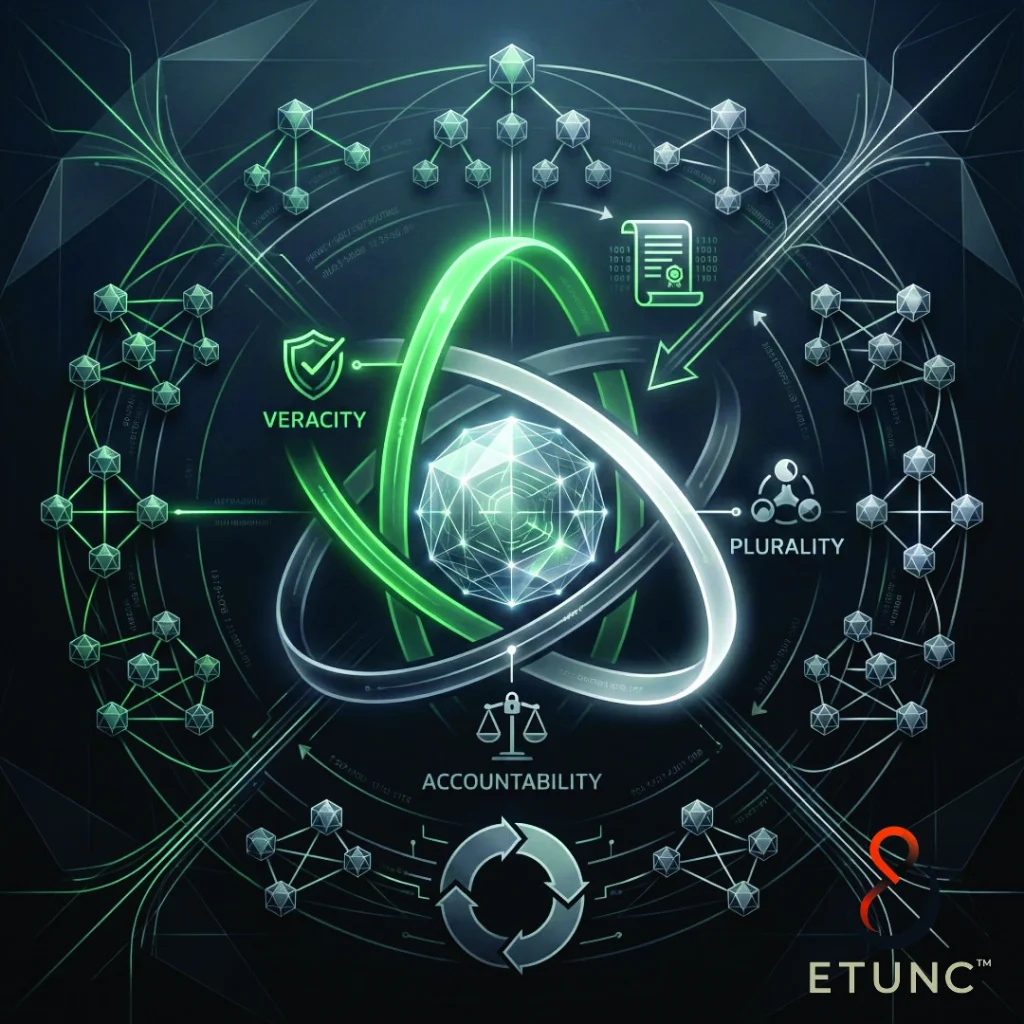
- Veracity: correctness must be robust under operational uncertainty
- Plurality: safe negotiation across diverse agent perspectives
- Accountability: attribution of actions across distributed execution chains
URL: https://arxiv.org/abs/2512.00520v1
2) AgentODRL: Multi-Agent ODRL Generation (arXiv:2512.00602v1)
ETUNC correspondence: Guardian reasoning layer (policy enforcement through structured validation)
- ODRL generation is a governance task: policy must be both syntactically valid and semantically faithful.
- The orchestrator-worker design reflects a “council” dynamic: specialization, aggregation, validation.
VPA linkage:
- Veracity: validator loops reduce drift from formal meaning
- Plurality: multiple workers enact perspective diversity (specialists)
- Accountability: traceable transformations from intent → policy artifact
URL: https://arxiv.org/abs/2512.00602v1
3) AgentNet++: Hierarchical Decentralized Coordination + Privacy (arXiv:2512.00614v1)
ETUNC correspondence: Envoy (distributed coordination infrastructure)
- Hierarchical decentralization provides a systems-level vocabulary for scale: clusters, tiers, role groupings, privacy-preserving sharing.
- This expresses the operational reality of agent ecosystems: knowledge cannot be globally pooled without trust and privacy mechanics.
VPA linkage:
- Veracity: integrity emerges from coordination + bounded sharing
- Plurality: hierarchy supports multi-role cognition without flattening into noise
- Accountability: theoretical guarantees become governance evidence
URL: https://arxiv.org/abs/2512.00614v1
4) Structured Cognitive Loop (SCL) (arXiv:2511.17673v2)
ETUNC correspondence: Guardian (traceable reasoning phases) + Resonator (validation of meaning alignment)
- Modular separation of retrieval / cognition / control / action / memory makes reasoning inspectable.
- Symbolic constraints act as policy surfaces—governance lives inside the loop.
VPA linkage:
- Veracity: constraint-aware reasoning reduces free-form error
- Plurality: modularity enables alternative reasoning paths to coexist and be compared
- Accountability: full trace across phases supports audit narratives
URL: https://arxiv.org/abs/2511.17673v2
5) Neuro-Symbolic + Blockchain-Enhanced Regulatory Intelligence (Preprint, Dec 2025)
ETUNC correspondence: Resonator (neuro-symbolic validation + compliance evidence anchoring)
- Combines neuro-symbolic workflows with immutable logging and fairness-aware auditing.
- This is the “institutional form” of Judgment-Quality AI: decisions become records, records become proofs.
VPA linkage:
- Veracity: immutable record of decision lineage
- Plurality: fairness metrics as structured plural-stakeholder accountability
- Accountability: auditability is an intrinsic system feature, not an external report
URL: (as provided: “Preprints,” Dec 2025 — link not included in your source list)
Section 3 — Ethical and Societal Context
Why Trust Calibration Is Becoming a Design Requirement
Agent ecosystems introduce a new social contract. The public expectation shifts from “don’t be wrong” to:
- Don’t be wrong in ways that cause harm.
- When wrong, fail safely.
- When uncertain, expose uncertainty.
- When acting, be attributable.
This is where ETUNC’s VPA framing becomes a publication-grade statement of principle rather than a branding device:
- Veracity becomes operational: truth in the presence of drift, incomplete observability, and tool dependencies.
- Plurality becomes structural: multiple perspectives are not “optional,” they are how systems avoid single-failure epistemology.
- Accountability becomes enforceable: logs, constraints, and audit narratives are part of the runtime.
The ethical point is not abstract. It is architectural: if a system can act, it must be governable. If it is governable, its governance must be inspectable. And if it is inspectable, it can be held to standards that are worthy of institutions.
Section 4 — Thematic Synthesis / Trends
Three Convergent Shifts
1) Orchestration moves from “pattern library” to “safety substrate.”
The Internet-of-Agents framing and decentralized coordination research both treat orchestration as the new perimeter: where risk is shaped, amplified, or constrained.
2) Hybrid reasoning becomes the interface between capability and control.
SCL and neuro-symbolic compliance signal that interpretability and controllability are moving inward—into the design of cognition itself.
3) Accountability is hardening into cryptographic and formal mechanisms.
The compliance preprint’s immutable records and the validation-centric policy generation work illustrate a trend: accountability is being encoded into technical artifacts rather than promises.
Suggested Resource Links
ETUNC Insights (Internal)
- Judgment-Quality AI: How Multi-Agent Orchestration Validates ETUNC’s Ethical Designhttps://etunc.ai/2025/10/07/judgment-quality-ai-how-multi-agent-orchestration-validates-etuncs-ethical-design/
- Judgment-Quality AI at Scale: Interpretable Alignment, Hybrid Reasoning, and Distributed Agent Governancehttps://etunc.ai/2025/12/18/judgment-quality-ai-at-scale-interpretable-alignment-hybrid-reasoning-and-distributed-agent-governance/
Academic / Technical (External)
- “Toward a Safe Internet of Agents” — arXiv:2512.00520v1
https://arxiv.org/abs/2512.00520v1 - “AgentODRL…” — arXiv:2512.00602v1
https://arxiv.org/abs/2512.00602v1 - “AgentNet++…” — arXiv:2512.00614v1
https://arxiv.org/abs/2512.00614v1 - “Structured Cognitive Loop…” — arXiv:2511.17673v2
https://arxiv.org/abs/2511.17673v2 - “Neuro-Symbolic + Blockchain Regulatory Intelligence” — Preprint (Dec 2025)
(External URL not included in your source list.)
Conclusion
This week’s literature does not simply advance techniques; it advances an orientation: intelligence is becoming organizational. Systems are increasingly built as societies of agents—coordinated, bounded, and judged by the integrity of their process as much as their outputs.
The emerging shape of “trustable AI” is therefore not a single model with better guardrails, but a governed ecosystem: orchestration patterns with fail-safes, hybrid reasoning loops that expose control surfaces, privacy-preserving decentralization for scale, and accountability mechanisms that create durable evidence.
This is the terrain ETUNC is built to inhabit: Judgment-Quality AI, grounded in Veracity, Plurality, and Accountability—not as ideals, but as system properties.
Call to Collaboration
ETUNC welcomes collaboration with researchers and labs working on: agent safety, decentralized multi-agent coordination, hybrid neuro-symbolic control, policy-as-code governance, and auditable compliance systems.
If your work intersects these domains, we invite shared research dialogue and co-development exploration under a governance-first frame.
Next Week’s Watchlist
- Norm-governed multi-agent decision-making (agentic consensus processes)
- Trust-aware decentralized communication protocols (emergent trust metrics)
- Adaptive multi-agent resource allocation (efficiency under heterogeneity)